🛡️ Ensuring women’s safety remains one of the most critical challenges in today’s society. Environments that were once considered safe, such as educational institutions, workplaces, and hospitals, are increasingly witnessing incidents of harassment and violence. This project introduces a proactive solution using Machine Learning and surveillance analytics to detect potential threats before they occur.
📡 The system leverages live CCTV feeds and applies real-time analysis using person detection, gender classification, and face recognition algorithms. By identifying scenarios where a woman is alone for an extended duration, the system generates alerts and notifies authorities, enabling immediate intervention and preventing possible risks.
🚨 Problem Context and Motivation
👩 Women's safety significantly impacts their freedom to pursue education and careers. Several real-world incidents have highlighted the gaps in safety systems, even in controlled environments like campuses and workplaces. These incidents not only create fear but also affect long-term confidence and participation of women in professional and academic spaces.
📱 Most existing solutions focus on reactive measures such as mobile apps, wearable devices, or emergency alerts. However, these approaches place the burden of safety on individuals rather than creating a secure environment.
💡 This project is motivated by the idea that safety should be built into the environment itself, rather than relying on individuals to protect themselves.
⚙️ Proposed System
The proposed system integrates Machine Learning with existing surveillance infrastructure to create a smart monitoring system.
🔄 The workflow of the system includes:
- 📹 Monitoring live camera feeds in real-time
- 👥 Detecting the number of individuals in a frame
- 🧠 Identifying gender using a trained model
- ⏱ Tracking duration when a woman is alone
- 🚨 Triggering alerts if the duration exceeds a defined threshold (10 minutes)
📤 Once the threshold is reached, the system captures the image, performs face recognition, retrieves stored details, and sends alerts to the concerned authority along with live feed access.
🧪 Methodology
The system is built using three major algorithms:
-
👤 Person Detection Algorithm
Utilizes YOLO (You Only Look Once) for real-time detection and counting of individuals.
-
🧠 Gender Detection Algorithm
Uses a deep learning model trained on a dataset of approximately 4000 images to classify gender accurately.
-
🧬 Face Recognition Algorithm
Matches captured images with a database to retrieve identity details such as name, department, and contact information.
🔁 These algorithms work together continuously on live video streams to ensure proactive monitoring and quick response.
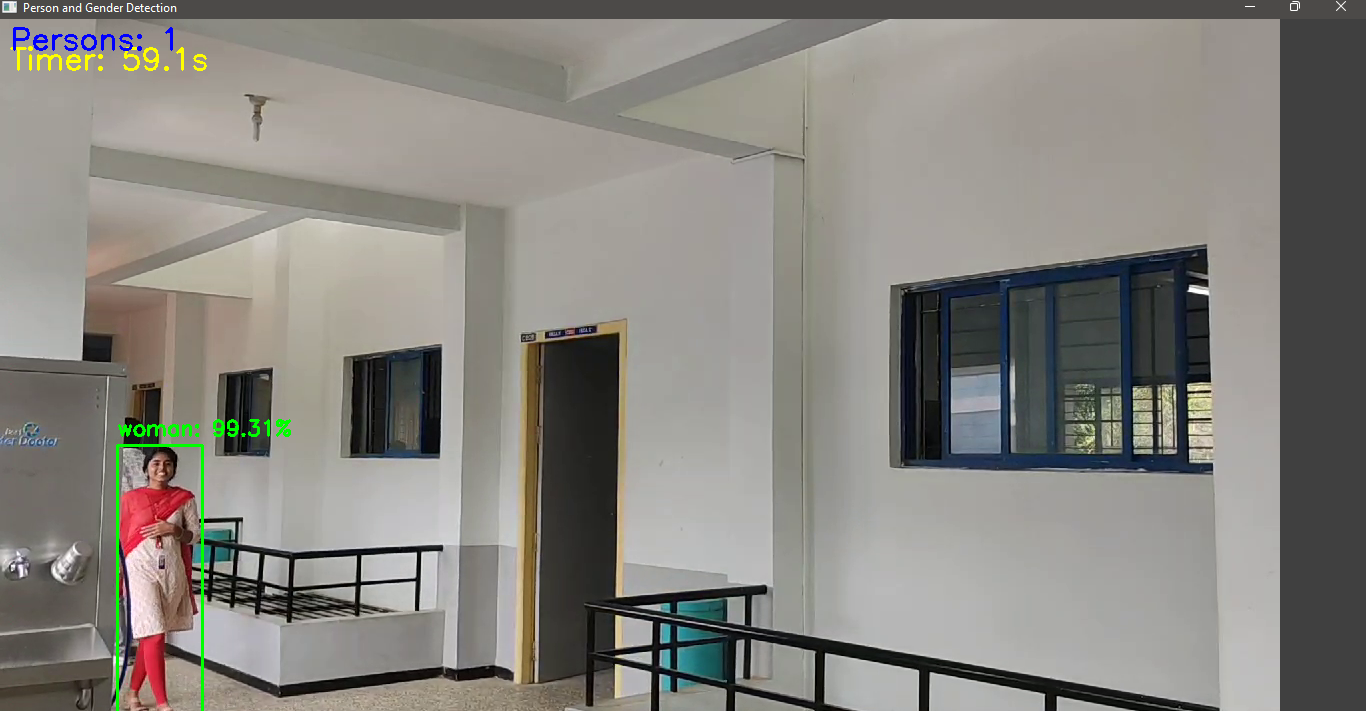 Real-time analysis and monitoring using AI-based surveillance
📊 Results and Observations
🧪 The system was tested in a real-time campus environment. During the experiment:
- ✅ The system successfully detected individuals in the camera frame
- ✅ Identified gender accurately
- ⏱ Initiated a timer when a woman was alone
- 🚨 Triggered alerts after the defined duration
- 📩 Retrieved and sent user details via notification system
📈 The gender detection model showed high accuracy with stable training and validation performance, ensuring reliable results in real-world scenarios.
🎯 Key Outcomes
- ⚡ Real-time threat detection
- ⏳ Reduced response time
- 💰 Cost-effective implementation using existing CCTV infrastructure
- 🎒 No dependency on wearable or manual safety devices
- 👁 Improved safety awareness and monitoring
🚀 Future Scope
The system can be further enhanced by:
- 🔍 Integrating behavioral analysis for detecting suspicious activities
- 🔊 Adding audio-based threat detection
- 📚 Expanding datasets for improved model accuracy
- 🔐 Incorporating privacy-aware AI mechanisms
- 🌆 Extending implementation to smart city infrastructures
🏁 Conclusion
🤖 This project demonstrates how Machine Learning and surveillance systems can transform passive monitoring into proactive safety solutions. By identifying potential risks before they escalate, the system helps create safer environments for women in campuses and workplaces.
🌟 The goal is not just to prevent incidents but to build a culture of safety, confidence, and empowerment where women can pursue their goals without fear.
⚠️ Copyright & Usage Notice
© 2025 Sudeep Bhagat. All Rights Reserved.
🚫 This content is original research work. Unauthorized copying, reproduction, or reuse of this material without permission is strictly prohibited.
- ❌ Do not copy or republish this content
- ❌ Do not use this project idea without proper credit
- ⚖️ Legal action may be taken against misuse
✅ Proper citation is required for academic or reference purposes.