🙏 I came here with nothing.
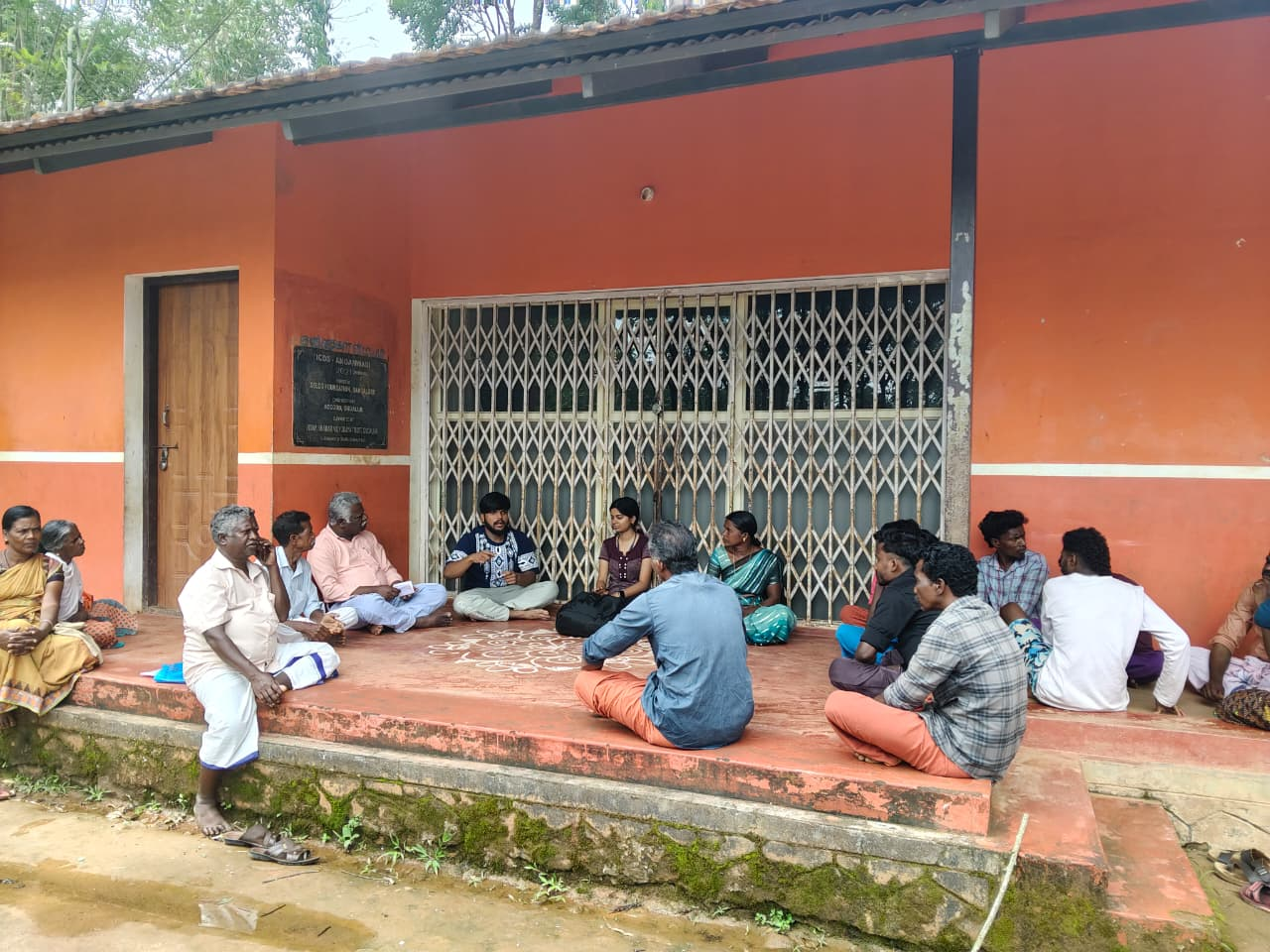
No fixed idea, no script, not even a clear question — just a mindset to observe, to sit with the community, and in many ways, to sit with myself.
As a field fellow in the Nilgiris, I expected to encounter traditions. What I did not expect was to witness a ceremony that made me fundamentally rethink what I thought I knew about prayer, healing, and community.
The Katunayakar community calls it Vita Poojay. And it is unlike anything I had seen before.
🌿 Not a Pooja Like Any Other
When you hear the word pooja, you might think of incense sticks, a brass lamp, and a priest reciting shlokas. You might think of something quiet, structured, contained.
Vita Poojay is none of those things.
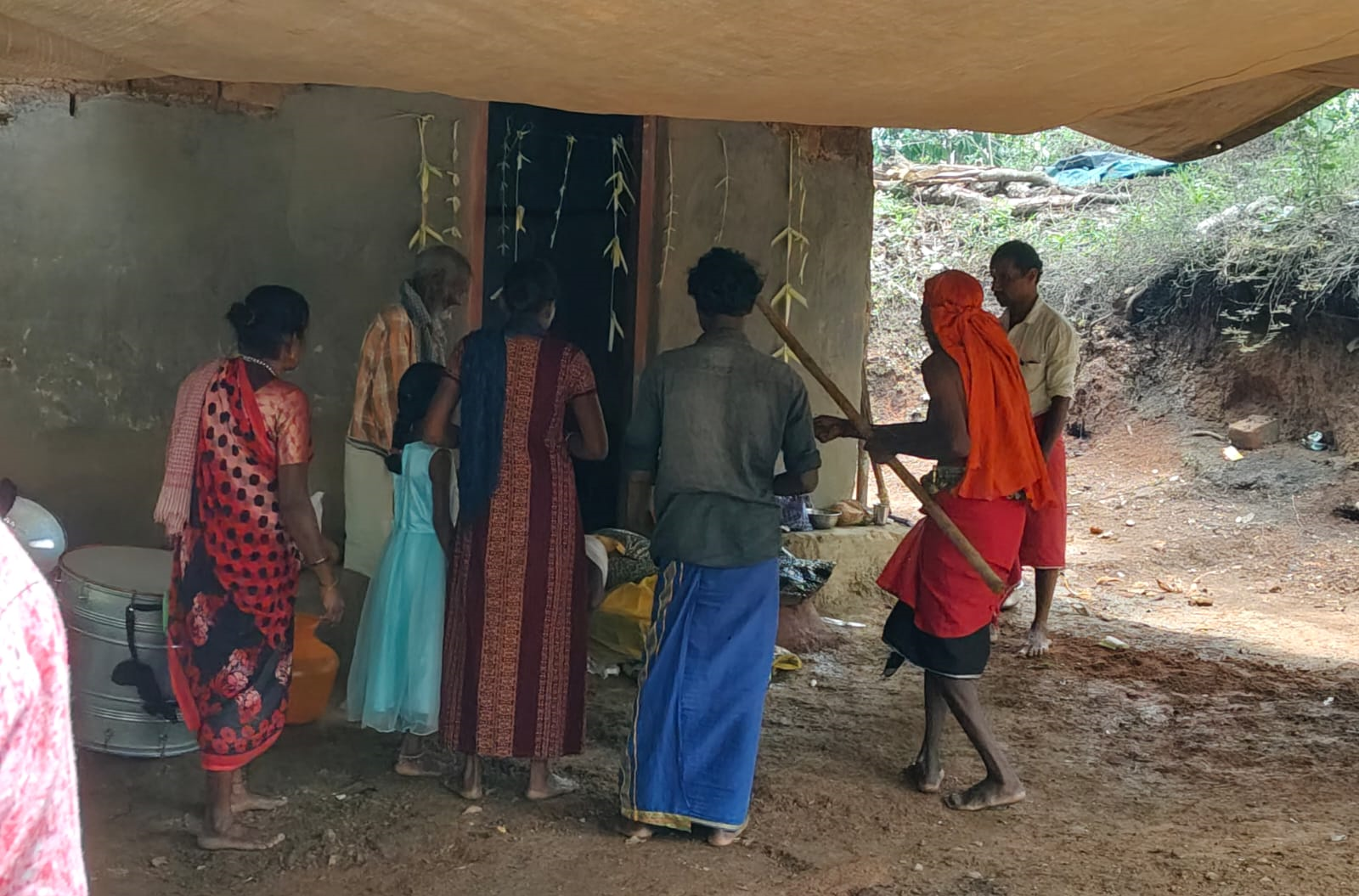
Yes, there is a pandit. Yes, there are tilak, offerings, and sacred statues. The community honours Goddess Saraswati, Lord Ganesha, and Lord Shivan. But the pooja does not end with prayer. It opens a door — and through that door, the divine walks in.
This is Sammi Adhana. Roughly translated: the coming of the Sammi. The Lord does not just receive offerings here — the Lord arrives, inhabits a human body, and dances.
This practice is not found in the same form among non-tribal communities, especially in North India. It is deeply rooted in the Katunayakar worldview — a worldview where the sacred is not distant, not sealed in stone, but living, responsive, and present.
🕰️ Four Poojas, One Continuous Sacred Thread
The Vita Poojay does not happen in an hour. It unfolds over two days — from Saturday evening to Sunday evening — in four distinct pooja sessions. Each round is its own complete ritual, yet all four together form a single, unbroken conversation between the community and the divine.
This rhythm matters. It mirrors the way the Katunayakar people live — attentive to cycles, to seasons, to the long arc of things rather than quick fixes.
Duration Saturday evening → Sunday evening
Pooja rounds 4 sessions
Deities honoured Saraswati, Ganesha, Shivan
Central practice Sammi Adhana (Lord dancing)
🥁 How the God Arrives: The Ritual in Steps
Two or three people from within the community are chosen to carry the divine. They are ordinary people — farmers, neighbours, members of the same village. But when the ritual begins, they become vessels.
- The pandit begins by applying tilak on the deity's image or statue. He then turns to the chosen person and applies the same tilak on them — a gesture that says: you and the god are being prepared together.
- The chosen person is dressed in a red vesti (lungi). Around their waist is tied a round, ringed bell belt — its sound will mark every movement of the god. A plate of fried rice rubbed with turmeric is placed first before the deity, then brought before the person.
- The pandit chants for 5 to 10 minutes. The traditional music begins — instruments that belong only to this community, instruments that carry their own memory and power.
- And then — the god comes in. The person begins to dance. This is Sammi Adhana. It is not performance. It is presence.
ś
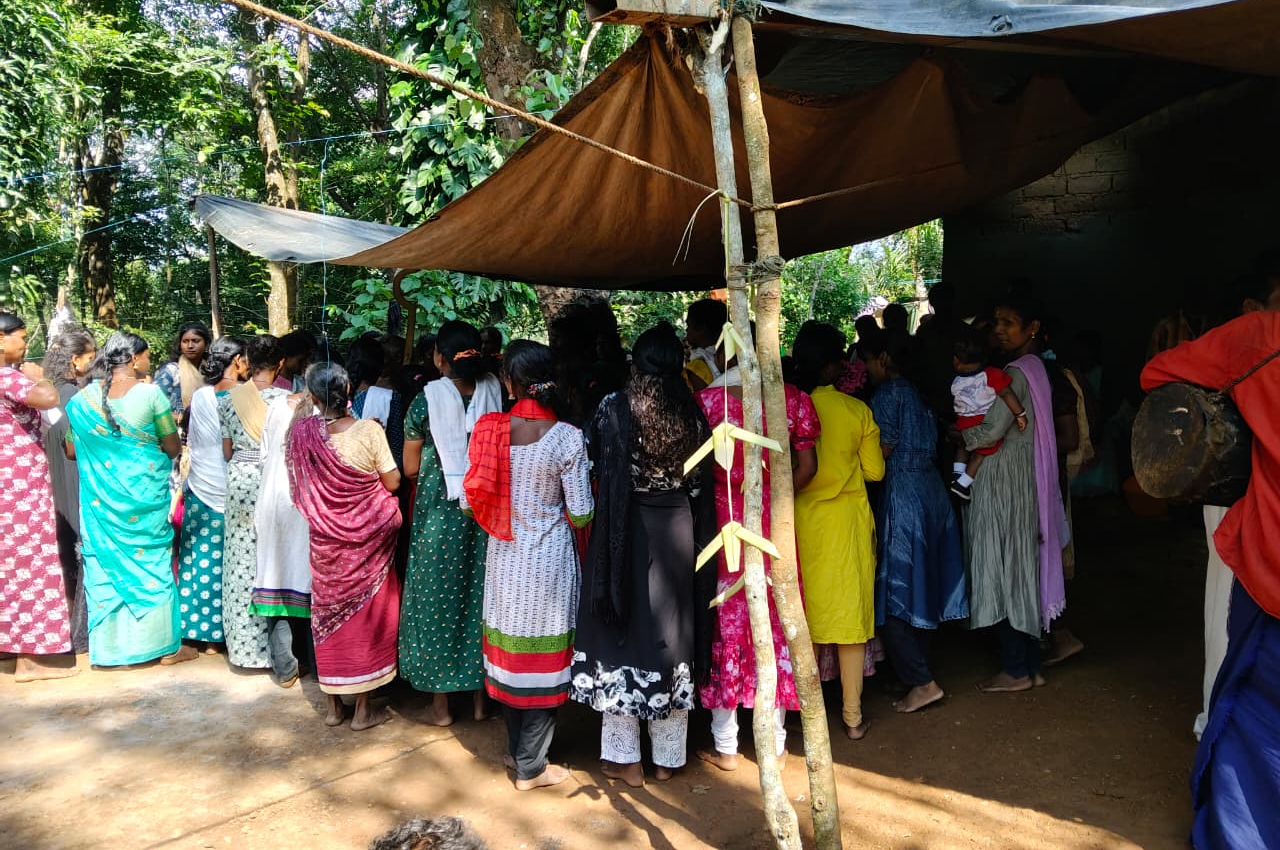 Receiving the blessing and solution directly from god
🎶 The Music Is Not Background — It Is the Call
One of the most important things I learned watching Vita Poojay is this: the traditional music is not decoration. It is the mechanism.
The instruments — played only during this ritual, by community members who carry this knowledge — are what create the conditions for Sammi Adhana. Without the music, the god does not arrive. The music is the invitation.
This is a form of indigenous knowledge that has no equivalent in mainstream religious practice. It is ecological, embodied, and precise.
🎶 The Music Is Not Background — It Is the Call
One of the most important things I learned watching Vita Poojay is this: the traditional music is not decoration. It is the mechanism.
The instruments — played only during this ritual, by community members who carry this knowledge — are what create the conditions for Sammi Adhana. Without the music, the god does not arrive. The music is the invitation.
This is a form of indigenous knowledge that has no equivalent in mainstream religious practice. It is ecological, embodied, and precise.
If someone needs guidance — a problem too tangled to solve alone — they can speak to the dancing person directly. The god listens. The dancing person takes the turmeric-applied rice, shakes it in their hand, speaks the answer, presses a portion of the rice onto the person asking — and releases the rest into the air or toward the ground. The question is answered. The rice carries it forward.
When everyone has received their blessing, the dancing person walks back toward the kovil (temple) entrance. At the gate, the god departs. The person returns to themselves. The pooja round is complete.
🍃 A Sacred Boundary: No Non-Veg on This Day
Before I describe how the ceremony ends, there is something important about how devotees enter it.
On the day of Vita Poojay, anyone who comes to the kovil as a devotee observes one firm rule: no non-vegetarian food for the entire day. From the moment they wake to the moment they leave, the body is kept clean — a form of preparation that signals respect, readiness, and intention.
The food served at the temple itself follows the same principle. Only vegetarian food is prepared and offered. No one goes home hungry — but the nourishment is purposefully chosen.
In the afternoon, as the final pooja sessions draw near, the community prepares food for all the devotees gathered. It is cooked and shared within the temple grounds. No one leaves empty-stomached. The meal is not just practical — it is part of the ritual. Sharing food together, in that sacred space, after hours of prayer and blessing, is itself an act of community.
💃 When Everyone Dances
And then something remarkable happens as the final pooja draws to its close.
The music — the same traditional music that called the god in — begins again. And this time, it is not just the chosen few who move. The entire community dances.
Every person who came to witness, every devotee who received a blessing, every elder and child who was present — they all join. The boundary between the sacred and the communal dissolves. The ritual that began with a chosen few becomes something that belongs to everyone.
This is one of the most profound things I have witnessed in all my time in the field. Collective joy, collective faith — not as metaphor, but as literal, physical, moving fact.
But Vita Poojay does not end at the temple gate. It ends at the water.
After the community dance, the person who carried the god — now returned to themselves — gathers certain gifts. They take with them the sacred items used in the pooja: offerings, ritual objects, gifts brought by devotees. And then the procession begins.
The community walks together — dancing, the whole way — to a river or stream. Not just any stream. The same one, used every year, in the same spot. That place is holy.
First line — The person who danced — who carried the god — walks at the front, holding a sword and the holistic ritual items used during the pooja. They lead the way.
Second line — The household members and devotees follow, carrying the gifts and offerings — the fruits, the sacred items, the things brought in devotion — that will be given to the water.
All along the path, the dancing continues. The music plays. The community moves together, in lines, toward the stream — a river of people returning something to the forest.
At the water's edge, the gifts are placed into the stream. And that is where Vita Poojay ends.
🌳 Why the stream? Why the forest?
The Katunayakar people hold a belief that is as simple as it is profound: their god lives inside the forest. Not in a temple made of stone — but in the living forest itself, in the trees and soil and streams that have always surrounded them. When gifts are placed in the stream, the water carries them inward — into the forest, to where the god resides. The ritual is complete only when the offering reaches its destination. The stream is not a symbol. It is the path home.
📖 What This Teaches About Community, Healing, and Development
I was trained to think about development in terms of infrastructure, income, and access. Vita Poojay reminded me that communities also develop — and sustain themselves — through meaning.
The Katunayakar people have built a system in which:
Mental and emotional burdens can be shared directly with a trusted sacred presence — not suppressed, not referred elsewhere, but addressed communally.
Knowledge about ritual, music, and spiritual practice is held within the community and passed down — not commodified or delegated to outsiders.
The divine is participatory — it responds, it speaks, it touches. Faith here is not passive. It is dialogic.
The ritual closes with a collective act of ecological reciprocity — gifts are returned to the forest, not kept. The community gives back to the land that sustains them.
For researchers in tribal welfare, rural development, and community health, Vita Poojay is a case study in holistic wellbeing. It is a community mental health system, a conflict resolution mechanism, a knowledge-transmission ceremony, an ecological practice, and a collective identity ritual — all in one.
This is not superstition. This is sophistication that development frameworks have not yet learned to see.
🌄 Still Learning
I am still here. Still observing. Still understanding what I witnessed in those two days — from Saturday evening to Sunday evening — as the drums played, the god arrived, the coconuts broke, the rice flew skyward, the community danced together toward a stream, and the gifts were given back to the forest.
What I know is this: the Katunayakar community does not need outsiders to bring them wholeness. They already have systems — ancient, living, working systems — for exactly that.
And yet, I cannot write this without acknowledging something that weighs on anyone who works in communities like this.
In many places, and in many ways, the newer generation is slowly losing its inheritance. Traditional foods are forgotten. Indigenous skills — how to read the forest, how to grow without chemicals, how to build with what the land gives — are fading. Languages thin. Crafts disappear. The thread between the old world and the new stretches and sometimes breaks.
But Vita Poojay is not lost.
What struck me most was not just that this ritual survived — it was who was keeping it alive. The youth of the Katunayakar community are not merely tolerating this ceremony or attending out of obligation. They are participating actively, following every step with sincerity, and holding the tradition with the same strictness and care as their elders. The dances, the procession, the rules of the day — the young people carry all of it. This is not preservation from the outside. This is faith from the inside.
In a time when we worry about what is being lost, Vita Poojay tells a different story. When something is truly alive in the hearts of people — when it speaks to who they are, where they come from, and what they believe — it does not need to be rescued. It simply continues. The youth are proof of that.
Faith, it turns out, is its own form of memory. Our job, as development practitioners, as researchers, as human beings, is not to replace these systems. It is to see them. To document them. And to make sure the world understands what is at stake when they disappear — and what is possible when they do not.
This blog is one small attempt at that.
⚠️ Copyright & Usage Notice
© 2026 Sudeep Bhagat. All Rights Reserved.
🚫 This content is original research work. Unauthorized copying, reproduction, or reuse of this material without permission is strictly prohibited.
- ❌ Do not copy or republish this content
- ❌ Do not use this project idea without proper credit
- ⚖️ Legal action may be taken against misuse
✅ Proper citation is required for academic or reference purposes.